If you’re looking for custom beanies with your company logo, you’ll quickly run into two very different types of products: fully custom knit beanies and pre-made blank beanies that are decorated with embroidery.
At first glance, they can seem similar. Both can carry your logo, both can be ordered in quantity, and both can work for company merchandise, events, teams, retail, or employee gifts. The difference is in how much control you have over the actual product.
With an embroidered blank beanie, the hat already exists. You choose from the styles and colors a supplier has in stock, then add your logo through embroidery, a patch, or another decoration method.
With a custom knit beanie, the product itself is being made for your project. You can have much more control over the yarn, colors, fit, knit structure, pattern, branding, labels, and other details.
Neither approach is automatically better. The right one depends on your budget, timeline, design, quantity, and what you want the finished beanie to represent.
Here’s how the two approaches compare.
What Is an Embroidered Blank Beanie?
A blank beanie is a finished, unbranded hat manufactured in advance and stocked by a wholesaler, apparel company, or promotional-products supplier.
When you place an order, a decorator takes that existing beanie and adds your artwork. Embroidery is one of the most common options because it creates a durable, professional-looking logo and works well on many standard cuffed beanies.
This process is similar to ordering custom T-shirts from a print shop. The shop usually isn’t manufacturing the shirt itself. It buys blanks from an apparel supplier and then adds the customer’s design.
There are several advantages to this approach. Since the beanie has already been manufactured, you can usually see exactly what style, fit, and color you are buying before decoration begins. It can also be a practical option when your only customization requirement is a relatively simple embroidered logo.
For a company that needs straightforward promotional merchandise, an employee uniform item, or a quick run of hats for an event, decorating an existing blank may be all that is necessary.
The tradeoff is that nearly every design decision outside of the logo has already been made for you.
What Is a Fully Custom Knit Beanie?
A fully custom knit beanie begins much earlier in the manufacturing process.
Instead of selecting a finished hat from a catalog, you work with the manufacturer to determine what the beanie itself should look like. Depending on the project, that can include the yarn, color combination, knit structure, length, fit, cuff, pattern, pom, labels, patches, and other details.
Artwork can even become part of the fabric itself.
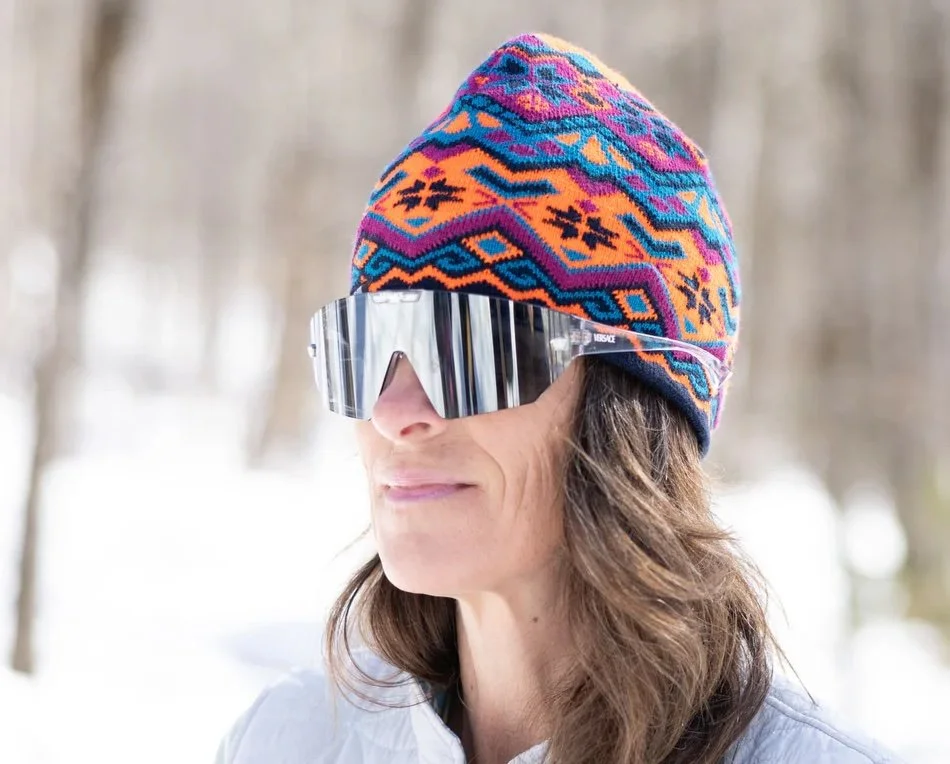
With custom jacquard beanies, logos, text, patterns, and graphics are created with different yarn colors during the knitting process. Rather than sitting on top of the finished hat, the design is built directly into it.
That opens up creative possibilities that simply aren’t available when you start with a finished blank.
A ski brand could create a repeating mountain graphic around the entire beanie. A brewery could incorporate its name directly into the knit. A school could combine team colors, lettering, and a pom into one cohesive design.
You’re designing the product, not just decorating it.
Embroidery Is a Decoration Method, Not a Type of Beanie
This is an important distinction because the terminology can get confusing.
An embroidered beanie is not automatically a blank beanie.
Embroidery simply describes the method used to apply the artwork. A custom manufacturer can knit a beanie specifically for your project and then embroider a logo onto the finished product.
Fourbital, for example, manufactures ribbed and other custom knit beanies in Vermont that can then be finished with patches, labels, embroidery, poms, and other branding elements.
So the real comparison isn’t necessarily jacquard vs. embroidery. It’s often custom manufacturing vs. decorating a pre-existing product.
If you’re deciding specifically how your logo should appear, our guide to embroidery vs. woven patches vs. jacquard goes deeper into the advantages of each branding technique.
The Biggest Difference Is Control Over the Product
When you buy a blank beanie, your options are limited to what the supplier has already decided to manufacture.
You might be able to choose between black, navy, charcoal, forest green, and several other stock colors, but you typically cannot change the yarn or alter the knit structure. You may be able to choose a cuffed or uncuffed style, but you usually cannot adjust the actual length or proportions of the product.
For many projects, that’s perfectly fine.
If you’re mainly interested in getting your logo onto a functional winter hat, having fewer decisions can actually make the process easier.
Custom manufacturing makes more sense when those details matter.
Maybe your brand needs a very specific silhouette. Perhaps you want colors that coordinate with an existing collection. You may want a chunky rib rather than a standard knit, or a jacquard pattern that wraps around the entire product.
Those are product-development decisions rather than decoration decisions.
This is why fully custom manufacturing tends to be particularly attractive to clothing brands, ski resorts, retailers, design-driven companies, and organizations that want the beanie to feel like a distinct piece of merchandise rather than a generic promotional item.
Custom Knit Beanies Offer More Color Possibilities
Color is another important difference.
With a blank beanie, the base color is limited to whatever the original supplier has produced. If your brand color falls somewhere between two available options, you generally have to pick the closest one.
When a beanie is being knitted specifically for your project, you can build the color palette around available yarn options instead.
This becomes especially useful with multi-color designs. Rather than using color only in the embroidered logo, you can incorporate several colors throughout the beanie itself.
A custom knit design can use stripes, repeating graphics, geometric patterns, lettering, contrasting cuffs, or other visual elements that make the entire product feel connected to the brand.
If you’re beginning a design from scratch, our guide to how to design a custom beanie covers the major choices involved, including construction, yarn, colors, branding, and finishing details.
Logo Design Works Differently on Each
Embroidery is excellent for many logos, particularly designs with clear shapes and lettering. Since thread is stitched onto the surface of the product, embroidery can create crisp details and a slightly raised texture that makes the logo stand out.
There are limitations, however. Extremely small text and very intricate artwork may not embroider cleanly, and a large embroidered design can become heavy or stiff.
Jacquard knitting has its own limitations. Because the artwork is created from knitted stitches rather than embroidery thread, very fine details may need to be simplified. The advantage is that the design can become much larger and more integrated into the product.
A logo doesn’t have to sit inside a small area on the front cuff. It can stretch across the beanie, repeat around it, or become part of a larger pattern.
Neither method is inherently superior. The best choice depends on the artwork and the look you want.
Our article on common custom beanie design mistakes explains why logo complexity, scale, contrast, and placement should all be considered before production begins.

Which One Looks More Like Retail Merchandise?
Both can.
A high-quality blank beanie with tasteful embroidery can look excellent. Many well-known clothing companies use relatively simple embroidered branding because it fits their aesthetic.
The difference is that fully custom manufacturing gives you more ways to make the product unique.
If customers can buy essentially the same blank beanie from dozens of other brands with only the logo changed, the product itself isn’t doing much to distinguish your company.
When the yarn, fit, knit structure, colors, pattern, labels, and finishing details have been selected specifically for your brand, the beanie has a better chance of feeling like a true part of your product line.
This is particularly important for companies interested in private label beanies. If you intend to sell the finished product under your own brand, controlling the product itself can be just as important as controlling the logo.
What About Minimum Order Quantities?
Blank beanies can sometimes have lower minimums because the manufacturing has already happened.
A decorator might only need to set up the embroidery equipment and apply the logo, which can make relatively small orders practical.
Fully custom manufacturing involves more setup. Yarn needs to be prepared, knitting machines may need to be programmed, artwork needs to be adapted for production, and the manufacturer needs to schedule an individual run.
That is why custom knit manufacturers generally use minimum order quantities.
The minimum does not necessarily need to be huge, though. Fourbital specializes in small-batch manufacturing, with typical minimum orders for custom beanies starting around 25 to 50 units depending on the style and customization.
That makes fully custom production much more accessible to smaller brands, shops, teams, and organizations than the very large minimums sometimes associated with apparel manufacturing.
How Does Pricing Compare?
An embroidered blank will often be the more economical option when you simply need an existing beanie with a logo added to it.
That makes sense. The product has already been designed and manufactured at scale, so your order is only responsible for the cost of the blank plus decoration and related setup.
A fully custom knit beanie includes more product development and manufacturing work. The final price can vary depending on the material, quantity, construction, number of colors, branding method, pom, labels, and other details.
The most useful comparison, however, isn’t always the lowest possible unit price.
If you’re selling the beanie at retail, giving it to an important customer, including it in a premium employee gift, or using it as part of a brand launch, the perceived value of the finished product matters too.
Our guide to custom beanie pricing explains how quantity, construction, customization, and other factors can affect the final cost.
Which Option Is Faster?
Because blank beanies already exist, they can usually be decorated more quickly than a product that still needs to be knitted.
If you discover that you need 50 hats for an event next week, a readily available blank may be your most realistic option.
Fully custom manufacturing requires additional time because the product has to go through design preparation, production, finishing, and shipping.
That extra time is part of what allows you to control more of the finished product.
If your launch or event has a fixed date, it’s worth discussing the timeline with your manufacturer before finalizing the design. Fourbital typically recommends planning custom production well enough in advance to allow for design approval and manufacturing.

When Should You Choose an Embroidered Blank Beanie?
A decorated blank can be a smart choice when speed, simplicity, or price is the primary concern.
It may make sense when you:
Need a straightforward company-logo beanie
Have a very tight deadline
Only need a small quantity
Find a stock style and color you already like
Don’t need to customize the fit or construction
Want embroidery to be the primary visual element
There is nothing inherently inferior about this approach. A good-quality blank with clean embroidery can make excellent company merchandise.
The important thing is understanding what you are buying.
When Should You Choose a Fully Custom Knit Beanie?
Custom manufacturing becomes more valuable when the beanie itself is part of the creative concept.
It may be the better choice when you:
Want your logo or artwork knitted directly into the product
Need a specific color combination
Want to control the fit or length
Are developing retail or private-label merchandise
Want custom labels, poms, patches, or finishing details
Need the product to feel distinctly different from standard promotional apparel
Plan to reorder the design or build a larger collection around it
For brands in particular, those additional choices can turn a simple logo item into a product customers recognize as your own.
Custom Knit vs. Embroidered Blank: Which Should You Choose?
If all you need is a familiar beanie with a clean logo on the front, there may be no reason to overcomplicate the project. A quality blank with embroidery can do the job extremely well.
If you want the beanie itself to become part of your brand identity, custom manufacturing gives you considerably more room to work.
You can choose the material and fit, build a color palette around your brand, create a jacquard pattern, add labels and patches, and make decisions about how the entire product should look rather than focusing only on the logo.
The best approach depends on what you want the finished beanie to accomplish.
Fourbital Factory manufactures custom knit beanies in Vermont for brands, companies, teams, retailers, resorts, events, and organizations. Whether you have a finished design or are still deciding between a ribbed beanie with an embroidered logo and a fully integrated jacquard pattern, contact Fourbital Factory to discuss the best production method for your project.
Frequently Asked Questions
What is the difference between a custom knit beanie and an embroidered blank beanie?
An embroidered blank beanie is a finished stock hat that is purchased from a supplier and customized afterward, usually by stitching a logo onto it. A custom knit beanie is manufactured specifically for the project, allowing more control over the yarn, colors, fit, knit structure, patterns, labels, and other design details.
Is embroidery or jacquard better for a beanie logo?
It depends on the design. Embroidery works well for smaller logos and creates a raised, textured finish. Jacquard knitting incorporates the artwork directly into the fabric and is particularly useful for larger graphics, repeating patterns, lettering, and designs that extend around the beanie.
Can a custom-made beanie still have an embroidered logo?
Yes. Embroidery is a branding method, not an indication that the beanie is a pre-made blank. A manufacturer can knit a custom beanie first and then add embroidery, patches, woven labels, or other finishing details.
Are custom knit beanies more expensive than embroidered blank beanies?
Fully custom knit beanies can cost more because the product is being manufactured specifically for the order rather than simply decorated. Pricing depends on quantity, materials, construction, colors, artwork, and finishing details. For retail and premium merchandise, the additional customization may also increase the perceived value of the finished product.
Can my logo be knitted directly into a beanie?
Yes. Jacquard knitting can incorporate logos, text, graphics, and patterns directly into the knit. Some artwork may need to be simplified or adjusted so that it reproduces clearly within the structure of the stitches.
What is the minimum order for fully custom knit beanies?
Fourbital Factory's typical minimum order is approximately 25 to 50 units depending on the style, number of colors, artwork, and other customization requirements.
Are fully custom beanies better for clothing brands?
They can be particularly useful for clothing brands because the manufacturer can customize more than the logo. Fit, yarn, colors, construction, labels, patterns, and finishing details can all contribute to a product that feels like a true part of the brand's collection.
Where are Fourbital Factory's custom knit beanies made?
Fourbital Factory manufactures its custom knit beanies in Vermont, USA.