When brands start designing a custom beanie, most of the attention naturally goes to the visible parts of the product: the yarn color, fit, knit pattern, logo, patch, or embroidery. Then, as production gets closer, a second group of questions usually appears.
Do we need a woven label? What should go on the inside tag? Should we add a hangtag? Do the beanies need individual packaging? How much of this actually matters?
These details can make a custom beanie feel like a complete retail product, but that does not mean every brand needs every available option. A simple beanie with one well-designed label can feel much more intentional than a product covered in tags, cards, and packaging that do not serve a clear purpose.
The right approach depends on what you are making, where it will be sold or distributed, and what you want someone to experience when they receive it.
Here is how to think about custom beanie labels, hangtags, and packaging before your order goes into production.
Start by Separating Branding From Product Information
It helps to divide labels into two basic categories.
The first is branding. This includes elements such as a woven logo label, hem tag, exterior patch, or another detail whose primary purpose is to identify the brand.
The second is product information. This can include fiber content, country of origin, manufacturer or marketer identification, sizing, and care recommendations.
Sometimes one label can handle several of these jobs. Other times, separating them creates a cleaner finished product.
For example, a brand might use a small woven logo label on the outside cuff and a separate interior label for the less visually interesting information. This allows the exterior branding to stay minimal without sacrificing the information customers may need.
If you are creating a product under your own brand rather than simply ordering promotional merchandise, these details become particularly important. Our guide to private label beanies covers the broader process of creating a beanie that is designed and presented as your own retail product.
Woven Logo Labels: The Most Versatile Branding Option
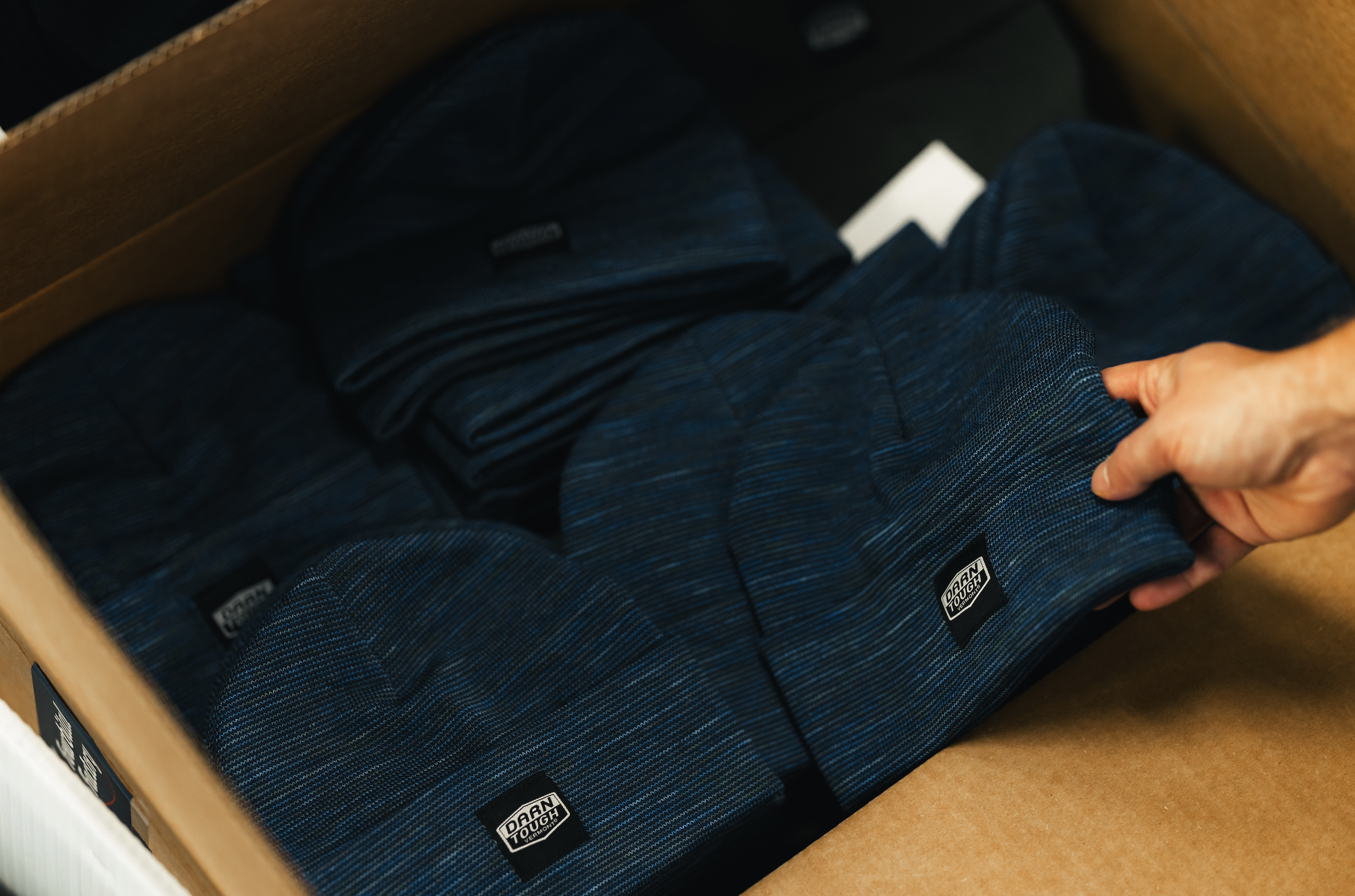
For many custom beanie projects, a woven label is one of the most useful finishing details you can add.
A small label attached to the cuff can provide clear brand identification without dominating the entire design. It works particularly well on solid-color and ribbed beanies where the goal is a cleaner, understated appearance.
Woven labels can also reproduce relatively detailed logos and lettering because the artwork is created within the label rather than directly through the larger stitches of the beanie itself.
Placement matters. A centered label across the front creates an obvious focal point, while a label positioned near the side of the cuff feels more subtle. Fold-over labels can wrap around an edge, while flat labels sit entirely on one surface.
The right choice depends on your brand aesthetic.
If the beanie already has a bold jacquard graphic, you may not need another large branding element. A small woven tag can be enough to identify the company without competing with the knit design.
This is a recurring principle in custom headwear: not every available branding area needs to be used.
Fourbital's guide to what to include on a custom beanie besides your logo explores how labels, color, and other small details can make a product feel more complete without overbranding it.
What About Hem Tags?
Hem tags are another option when you want the branding to be even more understated.
Rather than placing a larger label across the front of the beanie, a small tag can sit along an edge or seam. Someone may not immediately notice it from across the room, but it becomes visible when they pick up or examine the product.
That can work particularly well for fashion and lifestyle brands where the product itself is supposed to do most of the visual work.
A minimal ribbed beanie in a neutral color, for example, may not need a large logo at all. A small side tag can provide enough identification while preserving the clean design.
Hem tags can also complement other branding methods. A jacquard beanie might have the main artwork knitted into the fabric while a small tag identifies the company in a more traditional way.
The goal is not necessarily maximum logo visibility. The goal is to make the finished product feel intentional.

Interior Labels: The Details Customers Notice Later
The inside of a beanie is easy to overlook during the design process because it is not visible when someone is wearing it.
But interior labeling can make a significant difference in how complete the product feels.
When a customer picks up a beanie in a store, receives an online order, or turns the product inside out to check the material, a clean interior label reinforces the idea that this is a finished retail product rather than an unbranded hat with a logo added afterward.
Depending on the product and where it is sold, an interior label may include information such as the fiber composition, country of origin, brand name or responsible business, and optional care guidance.
If you are selling textile products in the United States, it is important to understand which labeling requirements apply to your specific product rather than treating these details as purely decorative.
Even when a particular piece of information is not legally required for your exact product, giving customers useful information can still make sense. If you are producing a merino wool beanie, for example, providing sensible care guidance can help customers maintain the product and avoid shrinking or damaging it.
Does a Beanie Need a Care Label?
This is an area where brands should be careful not to make assumptions based on other apparel products.
Many shirts, pants, jackets, and other garments are subject to federal care-labeling requirements in the United States. Hats, however, are exempt from the FTC's Care Labeling Rule.
That does not mean care information is useless.
If your beanie has specific washing or drying requirements, including those instructions can improve the customer experience and help extend the life of the product. This is especially relevant with materials such as merino wool, where improper washing or drying can affect the finished piece.
You can include care guidance on an interior tag, hangtag, packaging insert, or even a product page on your website.
The distinction is important: care information can be a valuable part of the product even when you are providing it voluntarily rather than because the Care Labeling Rule requires it for hats.
For brands preparing a first order, the custom beanie buyer's checklist is a useful starting point for thinking through labels, artwork, materials, quantities, and other production details.
Hangtags: Useful for Retail, Less Important for Giveaways
A hangtag serves a different purpose from a sewn-in label.
It is temporary. The customer will usually remove it before wearing the beanie.
That means a hangtag should earn its place by communicating something useful before it gets thrown away or recycled.
For a retail brand, hangtags can be valuable. They can carry a barcode or price sticker, identify the product, introduce the company, explain where the beanie was made, or communicate something about the material or manufacturing process.
They can also help merchandise a product in a physical store by giving retailers a consistent place for pricing and SKU information.
For a company handing out 100 beanies to employees at a holiday event, however, an elaborate custom hangtag may accomplish very little. Recipients already know who the product came from, and the tag will likely be removed immediately.
This is where brands sometimes spend money simply because something feels like a standard part of apparel production.
Ask what the hangtag actually needs to do.
If there is no clear answer, you may not need one.
Use a Hangtag to Tell a Story the Beanie Cannot
The best hangtags often communicate information that would be awkward to put directly on the product.
A beanie does not need a paragraph explaining your company philosophy stitched into the cuff. A hangtag gives you room for that message without affecting the design of the product.
For Fourbital customers, that could mean highlighting that the beanie was manufactured in Vermont. For an outdoor brand, it might explain why a particular yarn was selected. A collaboration could use the tag to introduce both companies involved in the project.
You can also connect the physical product to a digital experience using a QR code that leads to a collection page, brand story, care instructions, or other useful content.
Keep the message focused. A hangtag should not look like a folded brochure.
The product should still be the main event.
Does Every Custom Beanie Need Individual Packaging?
No.
Packaging decisions should be based largely on how the beanies will move from the factory to the final customer.
If 100 beanies are going directly to your office so they can be handed out to employees, individually packaging every hat for presentation may be unnecessary.
If you operate an e-commerce brand and every beanie will eventually be shipped to a different customer, individual presentation may matter much more.
The same is true for retail. A shop may want each unit prepared in a consistent way for inventory handling, while another retailer may prefer to receive the hats in bulk and merchandise them immediately on a table or display.
Think about what happens after the factory ships the order.
Will your team unpack every beanie and repackage it anyway? Are the hats going directly into fulfillment inventory? Do they need barcodes? Will stores receive different quantities or colorways?
Packaging should make that next step easier.
More Packaging Does Not Automatically Mean More Premium
There is sometimes an assumption that premium products require elaborate packaging.
That is not always true.
A beautifully made beanie does not necessarily become more valuable because it is placed inside multiple layers of branded material. In fact, excessive packaging can create the opposite impression, especially for customers who are trying to reduce unnecessary waste.
For many brands, a clean hangtag and thoughtful shipping presentation are enough.
If individual packaging is needed for protection, inventory, or fulfillment, choose something appropriate for that purpose. If it is purely decorative, ask whether it genuinely improves the customer experience.
The money you would spend on an unnecessary package may be better invested in higher-quality yarn, a better label, a stronger design, or another detail that remains with the beanie after the packaging has been discarded.
Think About E-Commerce and Retail Differently
A brand selling entirely online may have different packaging needs from one selling primarily through independent retailers.
With e-commerce, the customer opens a shipping package at home. That unboxing moment may be the first physical interaction they have ever had with your brand.
A hangtag, simple branded insert, or thoughtfully folded product can help reinforce the experience.
Wholesale and brick-and-mortar retail introduce different requirements. Stores may need clear SKUs, barcodes, style names, color information, pricing, or other inventory details.
If you plan to sell through retailers, ask them what they require before finalizing your tags and packaging. Creating beautiful hangtags only to discover that stores have nowhere to place their barcode stickers is an avoidable problem.
Your sales channel should help determine the presentation, not the other way around.
Don't Let Labels Become an Afterthought
Labels are small, which makes them easy to leave until the end of the design process.
That can create problems.
Label size and placement affect the appearance of the beanie. A label that looks proportional on a digital mockup might feel oversized once it is attached to a narrow cuff. A fold-over tag may require a different construction than a flat woven label. An interior label needs to be positioned where it will not become irritating when the beanie is worn.
These decisions are much easier to make before production begins.
Your manufacturer can also help determine whether your artwork will reproduce clearly at the label size you are considering. Tiny lettering and complex graphics may need to be simplified, just as they sometimes do with jacquard knitting or embroidery.
Our guide to custom beanie design mistakes covers some of the other issues worth addressing before approving a design for production.
What Does Your Brand Actually Need?
For many projects, the answer is simpler than brands initially expect.
If you are creating company merchandise or employee gifts, you may only need an exterior logo label or other visible branding. A hangtag and elaborate retail package probably are not necessary unless they serve another purpose.
If you are developing a private-label retail beanie, a branded exterior detail plus appropriate interior product labeling can make the product feel complete. A hangtag may also be useful for pricing, barcodes, product information, or storytelling.
If you are creating an e-commerce product, think about the entire fulfillment experience. You may want a hangtag, simple packaging, or an insert, but you do not need to add layers simply for the sake of creating an "unboxing."
If you are selling through wholesale retailers, ask what information those stores need before finalizing the tags. Inventory requirements may influence your hangtag design more than branding does.
In almost every case, start with what is necessary and add details only when they serve a clear function.
The Best Packaging Is the Part Customers Keep
Labels, hangtags, and packaging all contribute to presentation, but they do not carry equal weight.
The exterior label stays with the beanie.
The knit design stays with the beanie.
The material, fit, construction, and comfort stay with the beanie.
The hangtag and packaging usually do not.
That is a useful way to prioritize your budget.
Make the permanent product good first. Then add temporary presentation elements where they genuinely improve retail, fulfillment, communication, or the customer experience.
Fourbital Factory manufactures custom and private-label beanies in Vermont for apparel brands, outdoor companies, retailers, businesses, and organizations. From knit design and materials to branded labels, finishing touches, and packaging, we can help you decide which details make sense for the way your beanies will actually be sold or distributed.
If you are developing a new product, contact Fourbital Factory to discuss your beanie design, labels, packaging, quantity, and production goals.
Frequently Asked Questions
What labels should a custom beanie have?
The right labels depend on how the beanie will be sold and used. Brands often use an exterior woven logo label or hem tag for branding and a separate interior label for product information such as fiber content, country of origin, and responsible company identification. Retail and private-label products may require more information than simple promotional merchandise.
Do beanies need care labels?
Hats are exempt from the FTC's federal Care Labeling Rule, so they are not subject to the same care-label requirement as many other garments. Brands can still provide washing and drying instructions voluntarily, particularly for products such as merino wool beanies that benefit from more careful maintenance.
Do custom beanies need fiber-content and country-of-origin labels?
Most textile and wool products sold in the United States are subject to federal labeling requirements covering information such as fiber content, country of origin, and the identity of the manufacturer or another responsible business. Brands should confirm the requirements that apply to their specific product before production.
What is the difference between a woven label and a hangtag?
A woven label is sewn onto the beanie and remains part of the product. A hangtag is a removable tag generally used for temporary information such as pricing, barcodes, product details, brand storytelling, or retail presentation.
Does my brand need a custom hangtag?
Not necessarily. Hangtags are most useful for retail products where they provide pricing, SKU information, barcodes, product details, or brand storytelling. For employee gifts, event merchandise, or other products that will be handed directly to recipients, a hangtag may add little value.
Should custom beanies be individually packaged?
It depends on how the order will be distributed. Individual packaging can make sense for e-commerce fulfillment, inventory handling, subscription boxes, or certain retail programs. Beanies being distributed directly to employees, teams, or event attendees may not need individual presentation packaging.
What information can go on a custom beanie hangtag?
A hangtag can include your logo, product name, price, barcode or SKU, material information, manufacturing story, care recommendations, website, social media information, or a QR code. Keep the information focused on what will actually help the customer or retailer.
Can Fourbital Factory add custom labels and packaging to private-label beanies?
Yes. Fourbital's private-label manufacturing program can incorporate branded labels, packaging, and other finishing details as part of developing a retail-ready custom beanie.