If you're developing a custom beanie for your clothing brand, you may have come across the term "tech pack" while researching apparel manufacturing. It's a standard part of product development in the clothing industry, but knowing how much technical information you actually need to provide can be confusing, particularly if you're creating your first product.
The good news is that you don't necessarily need a professional tech pack to begin a custom beanie project. An experienced knitwear manufacturer can often work with reference images, logos, basic measurements, and a description of what you're trying to create.
However, if you're developing a product for retail, producing multiple colorways, or planning recurring manufacturing runs, having your specifications organized in one place can make the entire process more efficient.
Here's what a beanie tech pack should include, when you need one, and what information your manufacturer can help you figure out along the way.
What Is a Beanie Tech Pack?
A tech pack, short for technical package, is a document that communicates the design and manufacturing specifications of a product. It acts as a shared reference between the brand developing the product and the factory responsible for making it.
For a custom beanie, a tech pack might include technical drawings, measurements, yarn specifications, knit construction, color references, logo placement, label dimensions, and finishing requirements. More detailed versions may also contain a bill of materials, measurement tolerances, packaging instructions, and sample revision notes.
The purpose is to reduce ambiguity. Rather than leaving the manufacturer to interpret a design from several emails, sketches, and reference photos, a tech pack organizes those details into a single document that can be referenced throughout development and production.
This becomes particularly useful when developing private label beanies for your clothing brand, where consistency between individual production runs can be just as important as getting the first design right.
Do You Actually Need a Tech Pack to Order Custom Beanies?
Not necessarily. The amount of documentation you need depends largely on the complexity of your product and how much control you want over its specifications.
If you're ordering a straightforward ribbed beanie with a woven logo label, a few reference images, your preferred colors, and your logo files may be enough to begin development. If you're creating a retail collection with specific dimensions, custom jacquard patterns, multiple colorways, and branded finishing details, a tech pack becomes considerably more valuable.
At Fourbital Factory, we work with both brands that have completed technical specifications and customers who are starting with little more than an idea. Our team can help determine the appropriate materials, construction, dimensions, and branding methods based on what you're looking to achieve.
You shouldn't let the absence of a tech pack prevent you from contacting a manufacturer. In many cases, developing those specifications together is more productive than trying to finalize every technical detail before speaking with the people who will actually make the product.
What Should a Custom Beanie Tech Pack Include?
A useful tech pack doesn't need to be dozens of pages long. For most custom headwear projects, a relatively simple document covering the following areas provides a strong starting point.
1. Product Overview and Reference Images
Begin with a short description of the product you're developing. Include its intended use, target customer, and overall design direction.
A beanie designed for a premium outdoor apparel collection may have very different requirements from one developed for a streetwear brand, ski resort, or limited-edition collaboration.
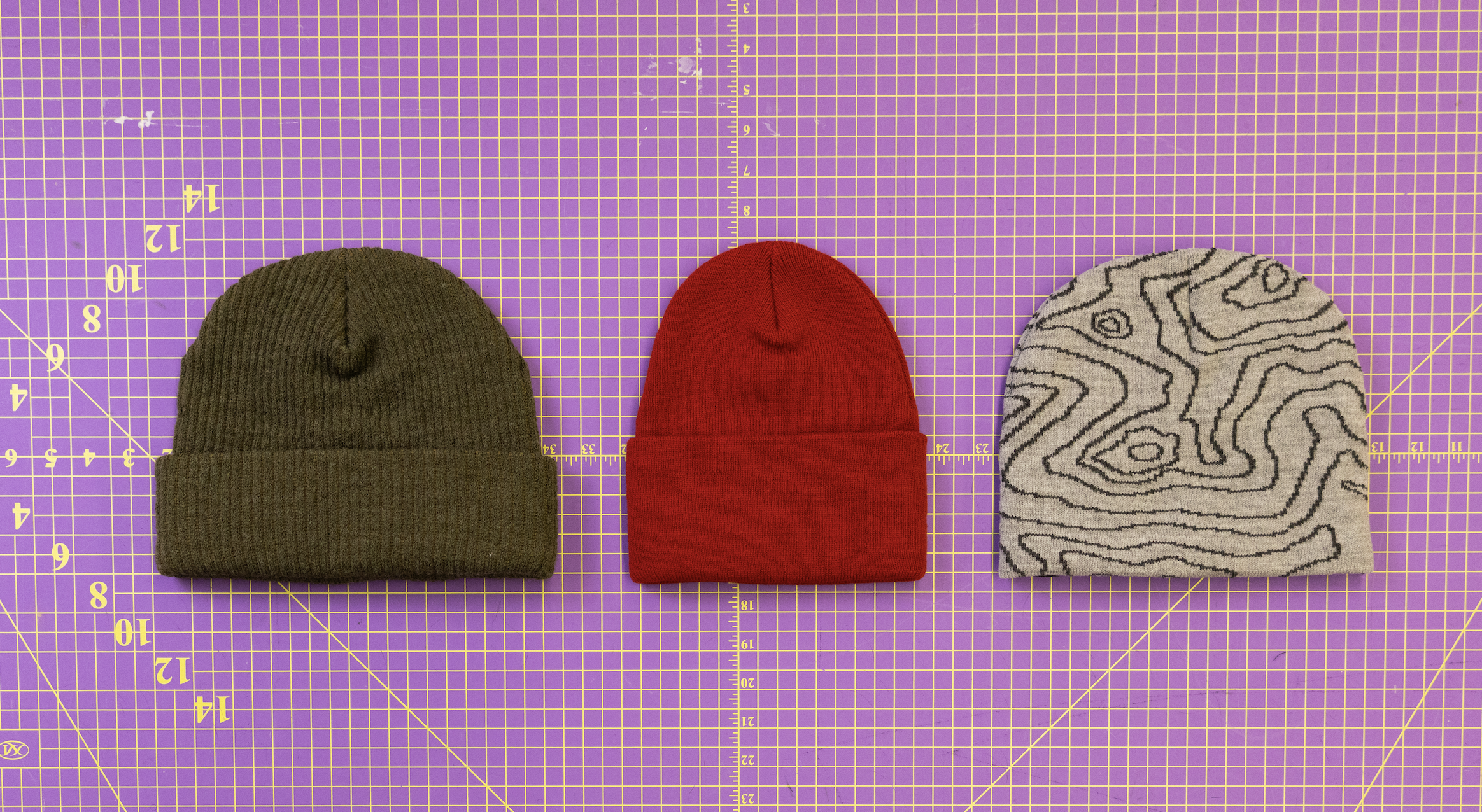
Reference images are especially helpful at this stage. They allow you to communicate proportions, textures, fit, and design details that can otherwise be difficult to describe.
If you're using an existing beanie as a reference, explain which aspects you want to carry over. You might like the length of one hat, the rib structure of another, and the label placement of a third. Combining those references with clear annotations helps your manufacturer understand what you're looking for without assuming you want to reproduce an existing product exactly.
2. Technical Drawings and Design Mockups
A technical drawing shows the beanie's shape, construction, and design elements without the distractions of photography or lifestyle imagery.
For a simple ribbed beanie, front and back views may be sufficient. More complex designs may benefit from side views, close-ups of branding details, or a flattened illustration showing how a jacquard pattern wraps around the hat.
These drawings should identify where important elements belong, including logos, stripes, cuffs, labels, patches, and pom-poms.
You don't need advanced illustration skills to communicate this information. A clearly annotated sketch or digital mockup can be just as useful during the initial development stage.
The manufacturer can then help translate that concept into a design that works with the actual knitting process.
3. Beanie Measurements and Fit
Measurements are one of the most important parts of a beanie tech pack, particularly if you're trying to achieve a specific silhouette.
Terms such as "short," "oversized," "fisherman-style," and "slouchy" can mean different things to different people. Providing actual dimensions gives the manufacturer a much clearer understanding of your expectations.
Useful measurements can include:
Overall height when laid flat
Height with the cuff folded
Width when laid flat and unstretched
Folded cuff depth
Height from the bottom edge to the crown
Logo or label dimensions
Distance between branding elements and the cuff edge
Make sure you specify whether your measurements are in inches or centimeters and whether the beanie is being measured folded, unfolded, relaxed, or stretched.
It's also important to understand that knitted products naturally stretch and relax. Rather than specifying unrealistically tight measurement tolerances, work with your manufacturer to establish acceptable variations for the chosen yarn and construction.
4. Knit Construction
The knit structure influences how a beanie looks, stretches, fits, and feels. It also determines which types of graphics and branding can be incorporated directly into the fabric.
Fourbital Factory offers several constructions, including 1×1 rib, 3×1 rib, chunky rib, and custom jacquard, along with different lengths such as skully, midi, and cuffed styles.
If you already know which construction you want, include it in your tech pack. If you don't, reference images showing the desired texture and appearance can help your manufacturer recommend a suitable option.
Jacquard is particularly useful for incorporating patterns, lettering, and graphics into the knit, while ribbed constructions are often a good starting point for more understated products with woven labels or patches.
Our guide on how to design a custom beanie explains how these construction choices influence the overall product.
5. Yarn and Material Specifications
Your tech pack should identify the material you want to use, if you have a preference. Material selection affects softness, warmth, durability, care requirements, production cost, and the overall positioning of the finished beanie.
Premium acrylic is a versatile option for branded headwear, while merino wool may be better suited to collections that emphasize natural fibers or outdoor performance.
If you're an established apparel brand with specific material requirements, you may already have information about fiber composition, yarn weight, or other technical characteristics. Include those specifications, but confirm their compatibility with your manufacturer's equipment and available materials.
For newer brands, a description of the desired feel and performance is often enough to begin the conversation. Your manufacturer can help narrow down the options without requiring you to become an expert in yarn before placing an order.
6. Color References and Colorways
Color specifications should identify not only the colors you want to use but also where each color appears on the finished product.
For a solid ribbed beanie, this may be relatively straightforward. For a multi-color jacquard design, you may need to identify the background color, graphic colors, cuff color, and any contrasting elements.
Pantone references are helpful for communicating brand colors, but it's important to understand that a digital color value or printed Pantone swatch may not correspond exactly to an available yarn color. Yarn texture, lighting, and surrounding colors can also influence how a shade appears.
Fourbital Factory offers more than 40 acrylic yarn colors and 15 wool yarn colors, providing a broad starting palette for custom designs.
Whenever possible, confirm your final color selections against physical yarn references or an approved sample. If you're developing several colorways, give each one a distinct name or product code so there is no confusion during production.
7. Logo Files and Artwork
Include the original artwork files for any logos, graphics, patterns, or lettering that will appear on the beanie.
Vector formats such as AI, EPS, and SVG are generally preferable because they allow artwork to be resized and adapted without losing image quality. High-resolution PNG files may also be useful, depending on the branding method.
In addition to the artwork itself, indicate its intended dimensions, placement, orientation, and application method.
For jacquard designs, remember that artwork is reproduced using knitted stitches rather than ink or individual embroidery threads. Fine details, gradients, and small lettering may need to be adjusted before manufacturing.
You don't necessarily need to convert your artwork into a stitch-by-stitch knitting pattern yourself. An experienced manufacturer can help determine how to translate the design into a workable knit structure.
Our article on custom beanie design mistakes covers several common artwork and placement issues worth addressing before production begins.
8. Labels, Patches, and Finishing Details
A complete tech pack should also document the smaller components that contribute to the finished product.
If your beanie includes a woven label, specify its dimensions, colors, placement, artwork, and whether it should be flat or folded over an edge. If you're incorporating a patch, include the desired shape, size, material, and positioning.
Other details may include pom-pom colors, interior product labels, hem tags, hangtags, and any required product information.
For retail products, these finishing elements can help establish consistency across your collection. It's much easier to reproduce a particular label placement during a future order if the dimensions and location have already been documented.
9. Packaging and Retail Requirements
If your beanies are being manufactured for retail or e-commerce, consider documenting how the finished products should be prepared for delivery.
That might include branded hangtags, individual packaging, SKU identification, barcode labels, or separating different colorways for inventory management.
Not every project requires these details. Beanies being distributed directly to employees or event attendees may only need straightforward bulk packaging. An apparel brand sending products directly into a fulfillment system may have more specific requirements.
Including these instructions early allows your manufacturer to account for finishing and packaging during the quotation process rather than introducing additional requirements after production has started.
10. Quantities, Budget, and Delivery Deadline
While these details aren't always included in a traditional garment tech pack, they are useful when communicating with a custom beanie manufacturer.
Include your estimated order quantity, quantity per colorway, target cost per unit, and the date you need the finished products delivered.
These factors can influence which materials, construction methods, and finishing details make the most sense for your project.
Fourbital Factory specializes in small-batch manufacturing, with minimums typically ranging from 25 to 50 units depending on the design. You can learn more about how production quantities work in our guide to minimum order requirements for custom beanies.
Example of a Simple Custom Beanie Tech Pack
A basic tech pack for a retail beanie might look something like the following. These are illustrative specifications rather than fixed Fourbital manufacturing requirements.
SpecificationExampleProduct nameClassic Ribbed BeanieStyle numberBN-001Intended useLifestyle and retail collectionKnit construction1×1 ribMaterialPremium acrylicOverall unfolded height28 cmFolded height21 cmRelaxed flat width20 cmCuff depth7 cmColorwaysBlack, forest green, oatmealBrandingWoven logo labelLabel dimensions40 × 25 mmLabel placementCentered on front cuffPom-pomNonePackagingBranded hangtagInitial quantity150 units, 50 per colorwayArtwork filesVector logo and label designRevisionVersion 1.0Sample approvalRequired before bulk production, subject to agreement
A document like this, accompanied by reference images and artwork, gives the manufacturer a clear foundation for discussing feasibility, pricing, sampling, and production.
The specifications don't all need to be finalized immediately. Some may change once you review available yarn colors, discuss construction options, or see the first physical sample.
What If You Don't Have a Tech Pack?
If you've never developed an apparel product before, creating a formal tech pack can feel unnecessarily complicated. Fortunately, you can often communicate most of the essential information in a simple email, PDF, or presentation.
Start by gathering a few images showing the type of beanie you like, your logo or graphic files, preferred colors, an approximate order quantity, and a short description of the finished product you have in mind.
If you have an existing beanie that fits particularly well, measuring it or providing it as a physical reference can also be helpful.
The goal is to communicate what matters to you while leaving room for the manufacturer to contribute their technical expertise. You may know exactly how you want the product to look without knowing which knitting method will achieve that result. That's where working with a specialist becomes valuable.
Our custom beanie buyer's checklist is another useful starting point if you're preparing your first manufacturing inquiry.
Don't Treat the First Version of Your Tech Pack as Final
A tech pack should evolve throughout the product development process.
You may discover during sampling that the cuff needs to be deeper, the logo should be slightly smaller, or a different yarn color produces a better result. Those adjustments are a normal part of developing custom knitwear.
Whenever a specification changes, update the document and record the revision. That ensures everyone is working from the same information and prevents earlier design instructions from accidentally making their way into production.
Once you've approved the final design or physical sample, your updated tech pack becomes a record of the product you want manufactured.
For projects where physical sampling is available, our guide on reviewing a sample before ordering custom beanies explains what to look for before approving a production run.
Why Tech Packs Make Repeat Orders Easier
One of the biggest advantages of maintaining a tech pack becomes apparent when you place your second or third production order.
If your first beanie collection sells well, you may want to reproduce the same product several months later. Without documented specifications, seemingly small details such as cuff depth, label placement, or yarn selection can be difficult to reconstruct.
A finalized tech pack gives your brand and manufacturing partner a consistent reference. It also makes it easier to introduce new colorways or develop variations of an existing product without starting the entire design process from scratch.
For growing clothing brands, that consistency can help turn a successful limited release into a permanent part of the product line.
Start With an Idea, Build the Specifications Together
A tech pack is a communication tool, not a prerequisite for creating great custom headwear.
Established brands may benefit from detailed technical documentation, particularly when managing multiple products, manufacturers, and recurring production runs. Smaller brands and first-time customers can often begin with much simpler information and develop the specifications alongside their manufacturer.
At Fourbital Factory, we manufacture custom knit beanies in Vermont and work with customers throughout the product development process, from initial concept and material selection to design approval, sampling, finishing, and production.
Whether you already have a complete tech pack or are still working out the details of your first product, start your custom beanie project with Fourbital Factory and share what you have. We can help turn your concept into a product that's ready for manufacturing.
Frequently Asked Questions
What is a tech pack for a beanie?
A beanie tech pack is a document containing the design and manufacturing specifications of a knitted hat. It typically includes technical drawings, measurements, materials, knit construction, colors, artwork, label placement, and finishing requirements.
Do I need a tech pack to order custom beanies?
No. A complete tech pack is not necessary to begin a custom beanie project with Fourbital Factory. Reference images, logo files, preferred colors, estimated quantities, and a description of your desired product are often enough to start development.
What measurements should a beanie tech pack include?
Useful measurements include overall height, folded height, relaxed flat width, cuff depth, logo dimensions, and label placement. Measurements should specify whether the beanie is folded, unfolded, relaxed, or stretched.
What file format should I use for a beanie tech pack?
PDF is a practical format for sharing a tech pack because it keeps drawings, specifications, and reference images together. Original vector artwork in AI, EPS, or SVG format should also be supplied separately when available.
Do I need to create my own knitting pattern for a custom beanie?
No. You can provide your artwork, reference images, and desired specifications without creating a technical knitting pattern. Your manufacturer can help adapt the design to the appropriate knit construction and production equipment.
Can I send a reference beanie instead of a tech pack?
Yes. A physical reference beanie can help communicate fit, dimensions, texture, and construction preferences. You should also explain which features you want to incorporate and which details should be different in your custom product.
Should I update my tech pack after sampling?
Yes. Any approved changes to measurements, colors, materials, branding, or finishing details should be reflected in the latest version of the tech pack. This helps maintain consistency during bulk production and future orders.
Can Fourbital Factory help develop my custom beanie specifications?
Yes. Fourbital Factory works with brands at different stages of product development, from initial ideas and reference images to completed technical specifications. Our team can help determine suitable materials, construction, colors, branding, and finishing details before manufacturing.